What Does a Common Slot Power Supply Mean?
Learn how HP Common Slot units work, fit servers, and support upgrades
-
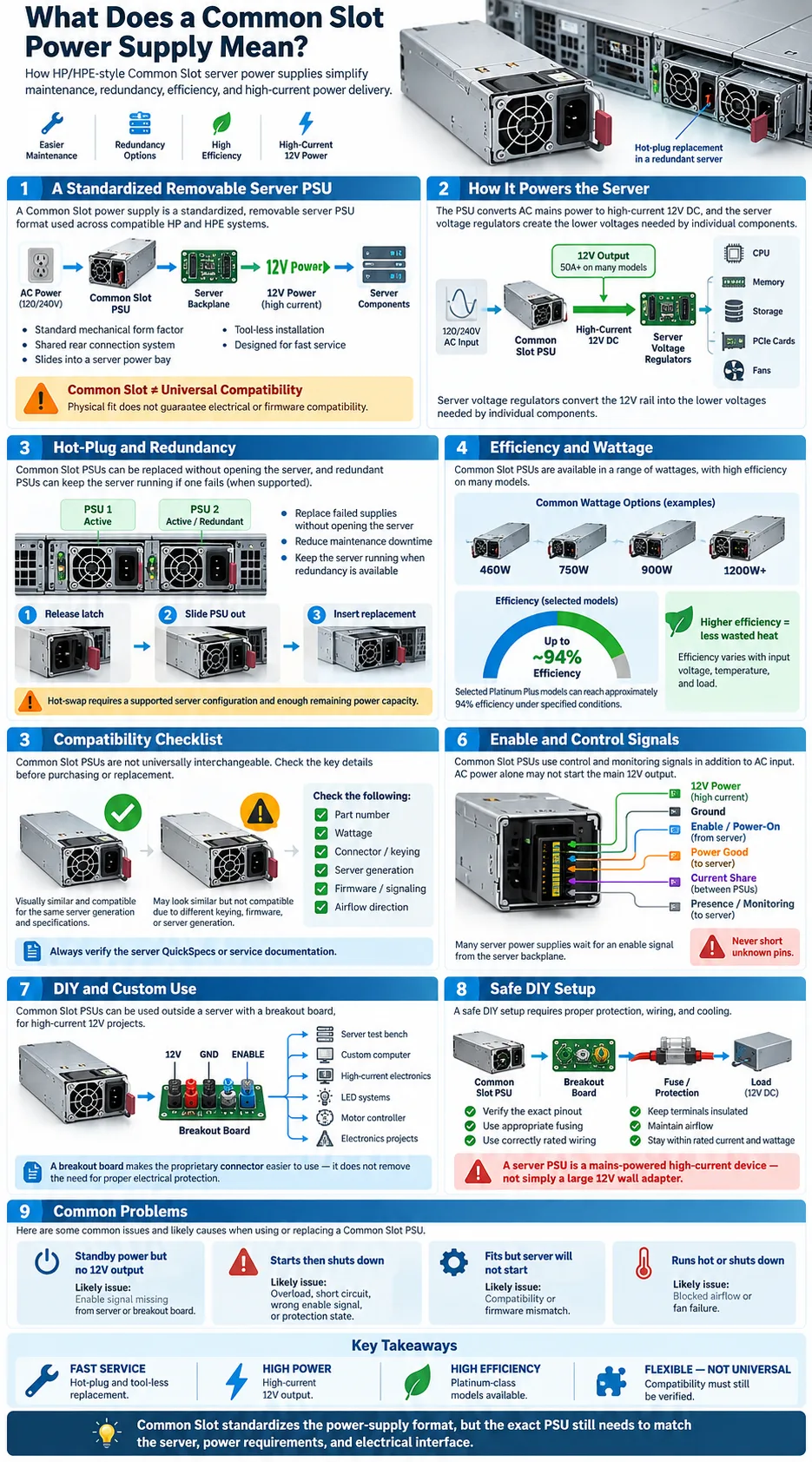
HP Common Slot units support hot-plug, tool-less installation, and faster server maintenance.
-
HP Platinum Plus models can reach up to 94% efficiency, reducing energy use and heat.
-
Many units provide more than 50 amps at 12 volts, making them useful for DIY power supplies and custom servers.
A Common Slot power supply is a removable server power module designed around a shared physical and electrical standard used across many HP and HPE systems. Instead of selecting a completely different supply for every server chassis, you can often use the same style of module across several compatible platforms. These units are best known for tool-free replacement, high current delivery, efficiency ratings, and support for redundant server power. However, Common Slot does not mean universal compatibility. Connector wiring, firmware expectations, output ratings, and chassis dimensions still matter, especially when you reuse a server power supply in a custom project.
What Is a Common Slot Power Supply?
Definition and Purpose
A Common Slot power supply is a standardized, removable AC to DC module used in selected HP and HPE servers, storage systems, and infrastructure hardware. The design combines a common mechanical form factor with a shared connection system, allowing a compatible module to slide into a power bay and connect to the server backplane. The module normally converts mains AC into regulated DC, most importantly a high-current 12 volt rail for the server's voltage regulators.
The main purpose is to simplify service. A technician can replace a failed module without removing the server from its rack or disconnecting every internal cable. A server power supply in this format may also operate in a redundant pair or group, so one module can continue powering the system while another is replaced.
History and Development by HP/HPE
HP introduced the HP Common Slot approach to reduce the number of unique power modules required across its ProLiant product families. HPE continued the design as server generations evolved, including systems such as the SL230s Gen8. The shared format helped data centers standardize spares while supporting newer efficiency levels and higher output ratings.
Compatibility still depends on the exact server, backplane, firmware, and power budget. A supply made for an E5-2697v2 system may physically fit another chassis but not provide the expected signaling or capacity. Always confirm the server maintenance guide and the label on the module before installing it.
Key Features of Common Slot Power Supplies
Hot-Plug and Tool-less Installation
Hot-plug operation lets you remove or insert a supported module while the server remains powered, provided the system has another active supply and the manufacturer permits the procedure. The supply usually slides along guide rails and locks with a handle or latch. This tool-less installation reduces service time and avoids opening the chassis.
Standardized Electrical and Physical Design
Common Slot modules use a repeatable enclosure, rear connector, airflow direction, and mounting arrangement. This modular design makes inventory management easier, but it does not make every model interchangeable. Different generations may use distinct power ratings, efficiency classes, pin behavior, or management signals. The AC inlet may be a rear power port IEC-60320-C14, although some higher-power models and systems use a different inlet arrangement.
High Efficiency and Power Ratings
Many units are available in 460 watt, 750 watt, 900 watt, 1200 watt, and higher ratings. The label may show an 80 PLUS certification, including platinum plus efficiency on selected HP models. A Platinum Plus module can reach up to about 94% efficiency under specified test conditions. Real results vary with input voltage, temperature, and load, but better efficiency means less wasted electricity and less heat for the server fans to remove.
Choose capacity based on the server's peak demand, not only its typical idle draw. Processors such as the E5-2650V2 and E5-2697v2 can create substantially different loads when multiple drives, memory modules, and expansion cards are installed.
How Does a Common Slot Power Supply Work?
Electrical Output and Voltage Specifications
Inside the module, an AC input stage rectifies and conditions mains power before switching circuits create a regulated DC output. Most Common Slot units provide a 12V output, often delivering more than 50 amps and sometimes considerably more. Server voltage regulator modules then convert that rail into the lower voltages required by CPUs, memory, chipsets, fans, and storage devices.
Do not assume the output is a simple laboratory-grade 12 volt source. The supply may expect a server backplane, control signal, minimum load, or communication link. Check the label for output current, input range, polarity, and protective features before connecting external equipment.
Enabling the Power Supply: Jumpers and Signals
Many modules do not start merely because AC is present. A standby circuit may remain active until the server asserts a power-on signal. In custom projects, users sometimes identify the required power supply jumper enable connection and pull it to the correct logic level through a jumper, switch, or controller. The exact pin and signal polarity vary by model, so copy a verified pinout rather than relying on a similar-looking unit.
Some Common Slot supplies also expose power-good, current-share, presence, or fan-control signals. Shorting unknown pins can damage the supply or connected hardware. Use a multimeter, current-limited test setup, and an authoritative pinout.
Cooling and Fan Integration
An internal fan moves air through heat sinks and switching components. In a server, the supply's airflow direction matches the chassis cooling path. If you use it on a bench, leave clear space around the intake and exhaust, and expect the fan to respond to load and temperature. Never block the grille or operate the module inside an unventilated enclosure.
Compatibility and Use Cases
Interchangeability Among HP/HPE Server Models
Power supply compatibility depends on more than a shared shape. Verify the part number, wattage, connector keying, firmware requirements, voltage range, airflow direction, and supported chassis. A Common Slot module may fit an HP ProLiant server but fail to start in another system because the backplane expects different enable or monitoring behavior. Consult the HPE QuickSpecs or service documentation for the exact platform.
Using Common Slot PSUs in Custom and DIY Projects
These modules are attractive for custom builds because they are compact, widely available, and capable of high current at 12 volts. You can use one for a server test bench, a high-current LED project, a motor controller, or a custom computer system. A safe conversion normally requires a verified connector pinout, an enable circuit, appropriate fusing, insulated terminals, and a load that stays within the rated output.
Do not treat the supply as an adjustable bench supply unless you add suitable regulation and current limiting. The output may rise or shut down when lightly loaded, depending on the design.
Redundant Power Supply Configurations
A redundant power supply arrangement uses two or more modules so the server can keep running after one fails. For stronger resilience, connect each module to a separate circuit or UPS. Redundancy protects against a module failure, but it does not increase the safe capacity of every server indefinitely. The backplane and system firmware determine how current sharing and failover work.
The term power supply hot-swap describes replacing a module during operation. It is safe only when the remaining module has adequate capacity and the system supports the procedure.
Advantages of Using Common Slot Power Supplies
Ease of Maintenance and Replacement
The biggest practical advantage is faster service. A failed module can often be identified through the server's management interface, released from its bay, and replaced without removing the server from the rack. Keeping one tested spare can reduce downtime across several compatible systems. The common enclosure also makes it easier for technicians to recognize the correct installation method.
Energy Efficiency Benefits
Modern units waste less energy as heat than older low-efficiency models. Better power supply load efficiency can reduce electricity costs, rack heat, and the cooling work required by the data center. Efficiency is not fixed at one number. A supply often performs best within a middle portion of its rated load, while very light or very heavy operation can produce different results.
For a home lab, the savings may be modest in absolute terms, but lower heat and quieter fan behavior can still matter. For a rack filled with servers, the difference compounds across many supplies and operating hours.
Cost-Effectiveness and Availability
Because HP and HPE deployed Common Slot modules across many product lines, used and refurbished units are often easy to find. This can make replacement less expensive than a proprietary supply designed for one chassis. You should still compare the seller's part number, condition, test policy, and efficiency rating.
Low purchase price should not replace electrical checks. Inspect the casing, connector, fan, and label, and avoid modules with burnt contacts, corrosion, cracked insulation, or unknown modifications.
Common Slot Power Supply Accessories and Modifications
Breakout Boards for Custom Backplanes
A power supply breakout board converts the proprietary rear connector into accessible terminals, headers, or standard output connectors. It may expose the main 12 volt rail, ground, enable input, power-good status, and current-sharing signals. A useful board includes clearly marked polarity, adequate copper thickness, screw terminals or locking connectors, and a fuse position.
Check the board's current rating before drawing high current. Thin traces, small connectors, and loose screw terminals can overheat even when the supply itself is rated for hundreds of watts. Cover unused contacts so a metal tool cannot bridge live terminals.
Voltage Modifications for Battery Charging
Some hobbyists modify the feedback circuit to raise or lower the output for battery charging. This is a high-risk modification because it can defeat overvoltage protection, alter isolation margins, or cause unstable switching. A Common Slot module is not automatically a battery charger. A proper charger needs a charge profile, current control, reverse-current protection, and a way to stop charging at the correct voltage.
For most projects, use the server supply as a fixed 12 volt source and add a separate certified charger or DC to DC converter.
Integration with Microcontrollers and Monitoring
An Arduino, Raspberry Pi, or other microcontroller can monitor voltage, fan status, temperature, or power-good signals through suitable isolation and level shifting. Never connect a server supply signal directly to a microcontroller until you know its voltage and reference ground. Use a fuse, common-ground plan where appropriate, and an isolated interface when the circuit requires it.
Monitoring is useful for detecting overloads and fan failures, but it does not replace the supply's built-in protections or safe wiring practices.
Troubleshooting and Common Issues
Power Supply Compatibility Problems
If a module will not slide fully into the bay, stop rather than forcing it. Compare its part number, connector position, guide rails, wattage, and airflow direction with the server documentation. A supply can fit physically and still be electrically unsuitable. Check whether the chassis needs a minimum number of installed modules or a specific firmware revision.
Enabling Output Challenges
A module that shows standby voltage but no main output may be waiting for the server enable signal. This is one of the most common issues when reusing a unit outside its original system. Confirm the pinout with documentation or careful measurement, then apply the correct enable level through a protected test circuit. Do not guess based on wire color or connector position.
Also check for an overload, short circuit, insufficient load, incorrect polarity, or a latched protection state. Disconnect external wiring, cycle AC power, and test with a known-safe load. If the module repeatedly shuts down, do not bypass the protection circuit.
Fan and Cooling Failures
A failed or noisy fan can cause thermal shutdown even when the electrical output is correct. Inspect the intake for dust, verify that the blades spin freely, and confirm that the replacement fan has compatible voltage, current, speed control, and tachometer behavior. Some supplies monitor fan feedback and will shut down if the expected signal is missing.
Replace damaged fans with a properly rated part and keep the airflow path clear. If the supply smells burnt, shows discoloration, trips protection immediately, or has damaged capacitors, retire it rather than attempting an uncertain repair.
Common Slot power supplies give you a practical combination of high current, efficient operation, quick replacement, and broad availability. For an HP or HPE server, confirm the exact part number and platform requirements before installation. For a DIY project, verify the pinout, add fusing and current protection, and provide reliable cooling. Treat the module as a serious mains-powered device, not merely a convenient 12 volt adapter, and it can serve reliably in both server maintenance and carefully planned custom equipment.
What does Common Slot mean on an HP power supply?
Common Slot identifies a shared physical and electrical power module format used across compatible HP and HPE servers and storage systems. It simplifies replacement, but the modules are not universally compatible with every server.
Are all HP Common Slot power supplies interchangeable?
No. You must compare the part number, wattage, connector, airflow direction, firmware requirements, and server support list. A module may fit mechanically but fail to start or provide insufficient capacity.
Can you use a Common Slot power supply as a 12 volt power supply?
Often, yes, if you identify the correct enable pin and output terminals and add appropriate fusing and protection. The supply may require an enable signal or minimum load, so verify the exact model pinout before connecting equipment.
What efficiency can an HP Platinum Plus Common Slot supply achieve?
Selected HP Platinum Plus models can reach approximately 94% efficiency under specified test conditions. Actual efficiency changes with input voltage, temperature, and the percentage of rated load.
Can a Common Slot power supply be hot-swapped?
Yes, supported server configurations can usually replace a failed module while operating if another supply has enough capacity. Follow the server documentation and never assume hot-swap operation is safe in an unsupported custom setup.
Why does my Common Slot power supply turn on briefly and shut off?
Possible causes include an incorrect enable signal, overload, short circuit, insufficient load, damaged wiring, or a protection state. Disconnect the load, verify the pinout and polarity, and test with a controlled setup.