Seagate IronWolf Pro Hard Drives: Complete Models, Specifications and Buying Guide
Explore IronWolf Pro models from 2TB to 32TB, historical revisions, performance differences, compatibility and replacement considerations.
Seagate IronWolf Pro is a family of 3.5-inch SATA hard drives designed for network-attached storage (NAS), particularly business systems handling continuous operation, multiple users and demanding storage workloads. First introduced in 2016, the family has expanded from 10TB maximum capacities in its original lineup to 32TB models using heat-assisted magnetic recording (HAMR).
One important detail is easy to overlook: not every IronWolf Pro drive with the same capacity has the same specifications. Seagate has released multiple generations, revised model numbers and introduced different recording technologies over the years. This guide covers verified models, including older drives that may no longer appear in current product catalogs, explains the differences and identifies what to check before buying or replacing one.
-
IronWolf Pro drives are designed for business NAS workloads, with verified capacities from 2TB through 32TB.
-
Older models carry 300TB/year workload ratings, while newer NT models are generally rated for 550TB/year.
-
Always verify the exact model number and NAS compatibility before replacing or upgrading an existing drive.
What Is Seagate IronWolf Pro?
IronWolf Pro is Seagate's higher-workload NAS hard drive family. It is positioned above standard IronWolf HDDs and is intended for environments where shared storage, continuous operation and multi-drive configurations are common.
Typical applications include business file servers, backup repositories, shared creative storage, private cloud systems and larger NAS arrays. IronWolf Pro drives use a 3.5-inch form factor and SATA 6Gb/s interface, with 7200 RPM operation across the HDD models documented in this guide.
Where IronWolf Pro Fits in Seagate's Lineup
Standard IronWolf drives target general NAS applications, including home and small-office systems. IronWolf Pro is designed for heavier multi-user workloads and provides higher published workload specifications, rotational vibration management and five-year limited warranties on the models covered here.
Seagate Exos drives occupy a related but different position. Exos is primarily an enterprise and data-center storage family, with SATA and SAS variants depending on the model. IronWolf Pro emphasizes NAS optimization and integration with supported NAS platforms.
Important IronWolf Pro Features
- AgileArray: Seagate's NAS-oriented technology platform, incorporating features intended to support RAID operation and multi-drive storage environments.
- Rotational vibration sensors: Help compensate for vibration produced by multiple spinning drives operating inside the same enclosure.
- IronWolf Health Management: Provides drive-health monitoring and recommendations through supported NAS platforms. Available functionality depends on NAS manufacturer and system support.
- CMR recording: The verified HDD models in this guide use conventional magnetic recording, including newer HAMR-assisted designs.
- Workload ratings: Manufacturer specifications describe supported annual data-transfer workloads, which vary between generations.
- Rescue Data Recovery Services: Included with many models, subject to the product's specific coverage term, eligibility and regional conditions.
The product family remains active, with Seagate documenting IronWolf Pro HDD capacities through 32TB. See the official IronWolf Pro support catalog for manufacturer documentation and model-specific resources.
IronWolf Pro History and Generations
Seagate formally introduced IronWolf Pro in November 2016, expanding the IronWolf NAS lineup established earlier that year. The original Pro family included 2TB, 4TB, 6TB, 8TB and 10TB capacities, targeting small and midsize businesses that needed higher workload ratings than standard NAS drives.
The family gradually gained capacity, performance and reliability improvements. Early models commonly featured a 300TB/year workload rating and a 1.2-million-hour mean time between failures (MTBF) specification. Later NT-series models raised the published workload rating to 550TB/year, with MTBF specifications of 2.0 million or 2.5 million hours depending on the model.
Higher capacities also introduced changes in recording technology. Seagate's recent HAMR-based IronWolf Pro drives use heat-assisted magnetic recording to increase areal density while retaining CMR recording behavior.
The dates below represent verified family developments and announcements, not the individual release dates of every model number.
Seagate IronWolf Pro Development Timeline
| Year | Development | Significance |
|---|---|---|
| 2016 | IronWolf Pro introduced | Original NAS lineup through 10TB |
| 2017 | 12TB expansion | Higher capacity for NAS storage |
| 2019 | 16TB introduced | Increased capacity per drive bay |
| 2020 | 18TB introduced | Further high-capacity expansion |
| 2021 | 20TB introduced | 20TB CMR model with 300TB/year rating |
| 2023 | 22TB introduced | 550TB/year and 2.5M-hour MTBF specifications |
| 2024 | 24TB capacity | Helium-based and HAMR model designs documented |
| 2025 | 28TB and 30TB | High-capacity HAMR models reach retail channels |
| 2026 | 32TB introduced | Highest verified IronWolf Pro capacity |
Seagate IronWolf Pro Model List
The model number is the most reliable starting point when identifying an IronWolf Pro hard drive. Seagate has released multiple revisions at the same capacity, and specifications can differ substantially even when the products share the same family name.
The tables below organize 41 positively identified IronWolf Pro HDD model numbers into useful historical and technical groups. The inventory includes current high-capacity models, older NE-series drives, the newer NT series and additional historical revisions. Four other Z-suffix identifiers are discussed separately because their product-family classification is not consistently supported by Seagate's documentation.
Inventory limitation: These tables represent the models verified in the manufacturer's documents reviewed for this guide. They are not a certified exhaustive list of every regional, retail-packaged or OEM variant ever sold. Historical models should not automatically be considered discontinued simply because they are absent from the current retail catalog.
High-Capacity HAMR Models
Seagate's HAMR-based IronWolf Pro drives provide the highest capacities in the family. HAMR temporarily heats a small region of the recording medium during writing, allowing greater recording density. These drives use CMR track organization, not shingled magnetic recording (SMR).
The four models below use 7200 RPM spindle speeds, 3.5-inch SATA interfaces, 512MB caches and published 550TB/year workload ratings. Specifications are documented in Seagate's 28TB-32TB datasheet and 24TB HAMR datasheet.
IronWolf Pro HAMR Models: 24TB Through 32TB
| Model Number | Capacity | Cache | Max Sustained | Workload/Year | MTBF |
|---|---|---|---|---|---|
| ST32000NT000 | 32TB | 512MB | 285 MB/s | 550TB | 2.5M hours |
| ST30000NT011 | 30TB | 512MB | 275 MB/s | 550TB | 2.5M hours |
| ST28000NT000 | 28TB | 512MB | 270 MB/s | 550TB | 2.5M hours |
| ST24000NT031 | 24TB | 512MB | 240 MB/s | 550TB | 2.5M hours |
IronWolf Pro NT-Series Models
The newer NT-series family covers capacities from 2TB through 24TB in Seagate's consolidated datasheet. These models have a 550TB/year annual workload rating, 7200 RPM operation, CMR recording and five-year limited warranties.
The specifications are not identical across capacities. Models from 12TB through 24TB in the referenced NT lineup use helium-based designs, while the 2TB through 10TB models use air-filled designs. Cache sizes, sustained transfer rates and MTBF specifications also vary.
All models in this table are documented in the Seagate IronWolf Pro NT-series datasheet. The manufacturer's published NAS bay specification for this group is unlimited, although actual NAS compatibility still depends on the platform.
IronWolf Pro NT Series: Complete Verified Model List
| Model Number | Capacity | Design | Cache | Max Sustained | MTBF | Workload/Year |
|---|---|---|---|---|---|---|
| ST24000NT002 | 24TB | Helium | 512MB | 285 MB/s | 2.5M hours | 550TB |
| ST22000NT001 | 22TB | Helium | 512MB | 285 MB/s | 2.5M hours | 550TB |
| ST20000NT001 | 20TB | Helium | 256MB | 285 MB/s | 2.5M hours | 550TB |
| ST18000NT001 | 18TB | Helium | 256MB | 285 MB/s | 2.5M hours | 550TB |
| ST16000NT001 | 16TB | Helium | 256MB | 270 MB/s | 2.5M hours | 550TB |
| ST14000NT001 | 14TB | Helium | 256MB | 270 MB/s | 2.5M hours | 550TB |
| ST12000NT001 | 12TB | Helium | 256MB | 270 MB/s | 2.5M hours | 550TB |
| ST10000NT001 | 10TB | Air | 256MB | 263 MB/s | 2.0M hours | 550TB |
| ST8000NT001 | 8TB | Air | 256MB | 255 MB/s | 2.0M hours | 550TB |
| ST6000NT001 | 6TB | Air | 256MB | 250 MB/s | 2.0M hours | 550TB |
| ST4000NT001 | 4TB | Air | 256MB | 250 MB/s | 2.0M hours | 550TB |
| ST2000NT001 | 2TB | Air | 256MB | 226 MB/s | 2.0M hours | 550TB |
Earlier IronWolf Pro NE-Series Models
Many older IronWolf Pro drives use model numbers containing NE rather than NT. The distinction matters because Seagate's historical specifications differ from those of newer models with equivalent capacities.
The following models appear in Seagate's 2022 historical catalog. They carry a 300TB/year workload rating, a 1.2-million-hour MTBF specification, five-year limited warranties and 7200 RPM operation. The source documents specify support for up to 24 drive bays.
These are historical specifications, not confirmation that every model has been formally discontinued. The original manufacturer figures can be checked in Seagate's 2022 IronWolf Pro datasheet.
Historical IronWolf Pro NE Models
| Model Number | Capacity | Cache | Max Sustained | Workload/Year | MTBF |
|---|---|---|---|---|---|
| ST20000NE000 | 20TB | 256MB | 285 MB/s | 300TB | 1.2M hours |
| ST18000NE000 | 18TB | 256MB | 260 MB/s | 300TB | 1.2M hours |
| ST16000NE000 | 16TB | 256MB | 255 MB/s | 300TB | 1.2M hours |
| ST14000NE0008 | 14TB | 256MB | 255 MB/s | 300TB | 1.2M hours |
| ST12000NE0008 | 12TB | 256MB | 240 MB/s | 300TB | 1.2M hours |
| ST10000NE0008 | 10TB | 256MB | 240 MB/s | 300TB | 1.2M hours |
| ST10000NE000 | 10TB | 256MB | 240 MB/s | 300TB | 1.2M hours |
| ST8000NE001 | 8TB | 256MB | 240 MB/s | 300TB | 1.2M hours |
| ST6000NE000 | 6TB | 256MB | 220 MB/s | 300TB | 1.2M hours |
| ST4000NE001 | 4TB | 256MB | 220 MB/s | 300TB | 1.2M hours |
| ST2000NE001 | 2TB | 256MB | 220 MB/s | 300TB | 1.2M hours |
Original and Other Historical IronWolf Pro Models
Seagate released additional model revisions during the early years of IronWolf Pro. Several do not appear in newer consolidated specification tables, making historical datasheets important when identifying an installed drive.
These models are particularly relevant for maintaining older NAS systems. A drive such as ST8000NE0004 should not be assumed to have the same firmware, performance or hardware characteristics as ST8000NE001 or ST8000NT001 simply because all three are 8TB IronWolf Pro models.
The specifications below come from the original 2016 datasheet, the 2017 datasheet, and the 2018 historical datasheet. Published maximum transfer rates should be interpreted within the context of those document revisions.
Original and Historical IronWolf Pro Model Numbers
| Model Number | Capacity | Cache | Max Sustained | Workload/Year | MTBF |
|---|---|---|---|---|---|
| ST12000NE0007 | 12TB | 256MB | 250 MB/s | 300TB | 1.2M hours |
| ST10000NE0004 | 10TB | 256MB | 214 MB/s | 300TB | 1.2M hours |
| ST8000NE0004 | 8TB | 256MB | 214 MB/s | 300TB | 1.2M hours |
| ST8000NE0008 | 8TB | 256MB | 214 MB/s | 300TB | 1.2M hours |
| ST8000NE0021 | 8TB | 256MB | 214 MB/s | 300TB | 1.2M hours |
| ST6000NE0023 | 6TB | 256MB | 214 MB/s | 300TB | 1.2M hours |
| ST6000NE0021 | 6TB | 256MB | 214 MB/s | 300TB | 1.2M hours |
| ST4000NE0025 | 4TB | 128MB | 214 MB/s | 300TB | 1.2M hours |
| ST2000NE0025 | 2TB | 128MB | 195 MB/s | 300TB | 1.2M hours |
| ST2000NE0035 | 2TB | 128MB | 195 MB/s | 300TB | 1.2M hours |
IronWolf Pro Z-Suffix Models and Identification Issues
Some Seagate models use an NTZ suffix rather than the standard NT naming pattern. These deserve separate treatment because the manufacturer's documentation is not entirely consistent.
Four Z-suffix models are identified as IronWolf Pro in Seagate's support listings. However, the 2025 Z-series datasheet contains conflicting product-family language and specifications, so its figures should not automatically be applied to every Z model.
For ST16000NTZ01 and ST12000NTZ01, the published Z-series specification table provides cache and maximum sustained transfer figures. The more detailed specifications of ST10000NTZ01 and ST6000NTZ01 were not independently established in the research.
Z-Suffix Models Identified as IronWolf Pro
| Model Number | Capacity | Cache | Max Sustained | Verification |
|---|---|---|---|---|
| ST16000NTZ01 | 16TB | 256MB | 270 MB/s | Pro support listing |
| ST12000NTZ01 | 12TB | 256MB | 270 MB/s | Pro support listing |
| ST10000NTZ01 | 10TB | Not verified | Not verified | Pro support listing |
| ST6000NTZ01 | 6TB | Not verified | Not verified | Pro support listing |
Seagate also lists older ST8000NE0001 and ST8000NE0011 drives under Enterprise NAS HDD branding. These are related historical products, but the reviewed support documentation does not establish them as IronWolf Pro-branded models. They are therefore excluded from the confirmed IronWolf Pro inventory.
One additional naming distinction is worth making: IronWolf Pro 125 is a separate SATA solid-state drive family, not a generation of the mechanical IronWolf Pro HDD lineup. Its model numbers begin with ZA rather than ST and should be researched separately when identifying an SSD.
How IronWolf Pro Models Differ
Capacity is the most obvious difference between IronWolf Pro drives, but it is not always the most important. Two drives with the same capacity can use different internal designs, carry different workload specifications and deliver different published transfer rates.
Capacity and Storage Density
Seagate offers verified IronWolf Pro HDD models from 2TB through 32TB. Larger drives provide more capacity per bay, which is useful when the number of available drive slots is limited. However, a larger drive can also increase the amount of data involved in a RAID rebuild, making storage layout and backup planning especially important.
Annual Workload Ratings
Early IronWolf Pro models generally carried a 300TB/year workload rating. Newer NT-series and high-capacity HAMR models carry a 550TB/year rating. This figure describes the manufacturer's specified annual data-transfer workload, not how much data the drive can permanently store.
It is not a fixed lifespan or a guarantee against failure. A workload rating also should not be confused with an SSD's total bytes written endurance specification.
MTBF and Reliability Specifications
Mean time between failures (MTBF) is a statistical reliability metric. Historical IronWolf Pro models commonly specified 1.2 million hours, while newer drives specify 2.0 million or 2.5 million hours depending on capacity and generation.
Those figures describe statistical reliability under defined conditions. They do not mean an individual drive will operate for millions of hours without failure.
Cache and Transfer Rates
IronWolf Pro drives have used cache sizes ranging from 128MB on certain early models to 512MB on newer high-capacity drives. A larger cache can help particular operations, but it does not establish the drive's overall speed.
Published sustained transfer rates also vary. For example, ST20000NT001 and ST20000NE000 both advertise 285 MB/s maximum sustained transfers despite their different workload and MTBF specifications. The newer model's higher reliability rating does not automatically translate into faster sequential performance.
20TB IronWolf Pro Comparison: Older NE vs Newer NT
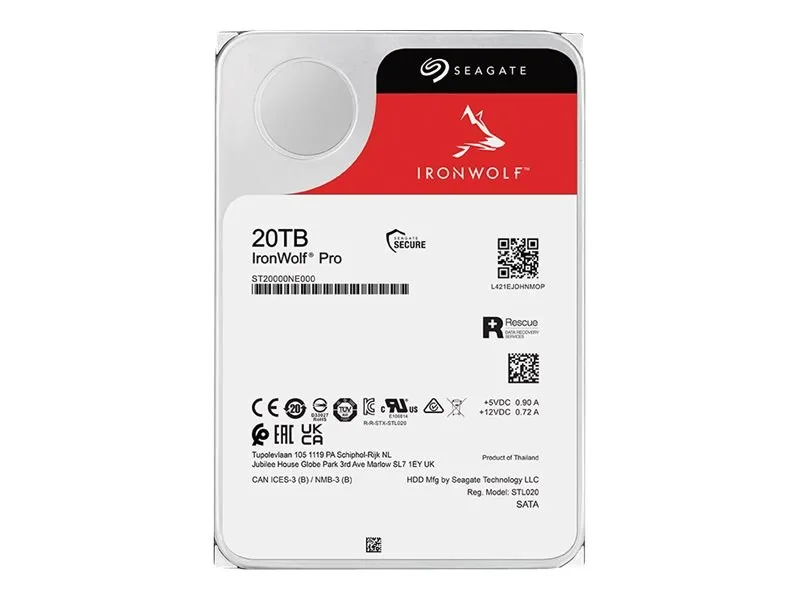
ST20000NE000 20TB
|
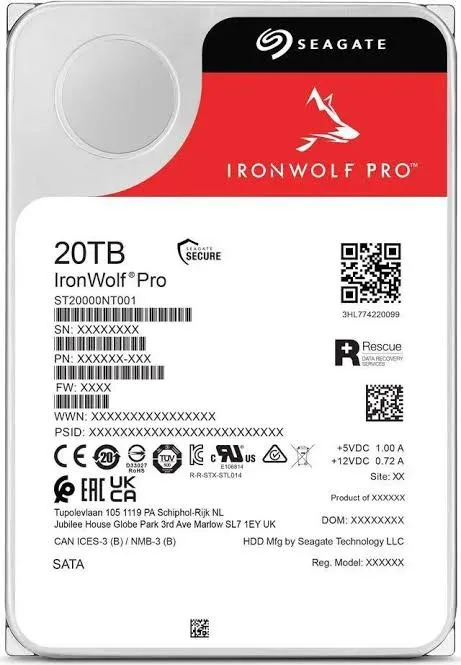
ST20000NT001 20TB
|
|
|---|---|---|
| Capacity | 20TB | 20TB |
| Interface | SATA 6Gb/s | SATA 6Gb/s |
| Cache | 256MB | 256MB |
| Max Sustained Transfer | 285 MB/s | 285 MB/s |
| Annual Workload | 300TB | 550TB |
| MTBF | 1.2M hours | 2.5M hours |
| Published NAS Bays | Up to 24 | Unlimited |
| Limited Warranty | 5 years | 5 years |
ST20000NE000 vs ST20000NT001
The 20TB models illustrate how IronWolf Pro has changed. ST20000NE000 is an older model with a 300TB/year workload rating and a 1.2-million-hour MTBF specification. ST20000NT001 maintains the same capacity, cache size and advertised maximum sustained transfer rate but increases the workload rating to 550TB/year and MTBF to 2.5 million hours.
The practical advantage is in the newer published workload and reliability specifications rather than a dramatic sequential speed improvement. ST20000NT001 is a potential newer alternative worth evaluating for an existing 20TB installation, but replacement compatibility must be checked against the actual NAS or storage controller.
Two Different 24TB IronWolf Pro Designs
The 24TB capacity provides one of the clearest examples of why an exact model number matters. ST24000NT002 and ST24000NT031 both belong to the IronWolf Pro family, but they are not the same drive internally.
ST24000NT002 is documented as a helium-based, non-HAMR model with a maximum sustained transfer rate of 285 MB/s. ST24000NT031 uses HAMR and has a published maximum sustained transfer rate of 240 MB/s.
The manufacturer also specifies different acoustic characteristics. ST24000NT002 is rated at 20 dBA typical idle and 26 dBA typical seek, compared with 28 dBA idle and 32 dBA seek for ST24000NT031.
Both models have 512MB caches, 550TB/year workload ratings, 2.5-million-hour MTBF specifications and five-year limited warranties. Their different hardware designs and published performance characteristics mean they should not be treated as identical products.
24TB IronWolf Pro: ST24000NT002 vs ST24000NT031
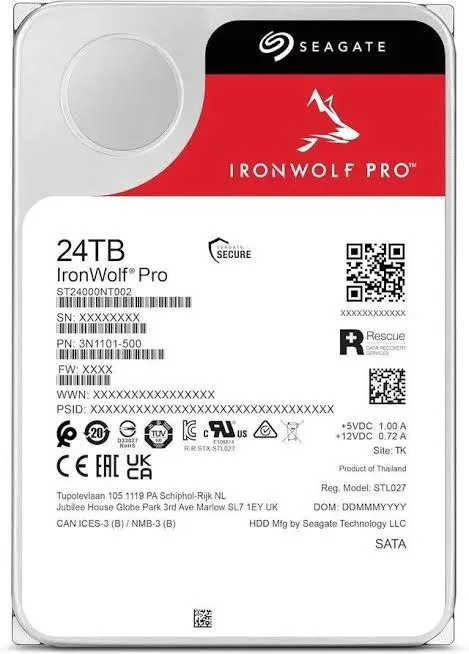
ST24000NT002 24TB
|
ST24000NT031 24TB
|
|
|---|---|---|
| Capacity | 24TB | 24TB |
| Recording Design | Helium-based CMR | HAMR-assisted CMR |
| Interface | SATA 6Gb/s | SATA 6Gb/s |
| Cache | 512MB | 512MB |
| Max Sustained Transfer | 285 MB/s | 240 MB/s |
| Annual Workload | 550TB | 550TB |
| MTBF | 2.5M hours | 2.5M hours |
| Average Operating Power | 7.8W | 7.8W |
| Typical Idle Noise | 20 dBA | 28 dBA |
| Typical Seek Noise | 26 dBA | 32 dBA |
28TB, 30TB and 32TB HAMR Models
Seagate's 28TB, 30TB and 32TB IronWolf Pro models belong to its high-capacity HAMR generation. They share 512MB caches, 550TB/year workload ratings, 2.5-million-hour MTBF specifications and published average operating power of 8.3W.
The main difference is capacity, followed by relatively modest changes in maximum sustained transfer rate. ST28000NT000 is rated at 270 MB/s, ST30000NT011 at 275 MB/s and ST32000NT000 at 285 MB/s.
For a NAS expansion, usable capacity, supported drive lists, enclosure cooling, rebuild planning and cost per usable terabyte may be more important than these small differences in advertised sequential transfer rates.
28TB vs 30TB vs 32TB IronWolf Pro HAMR
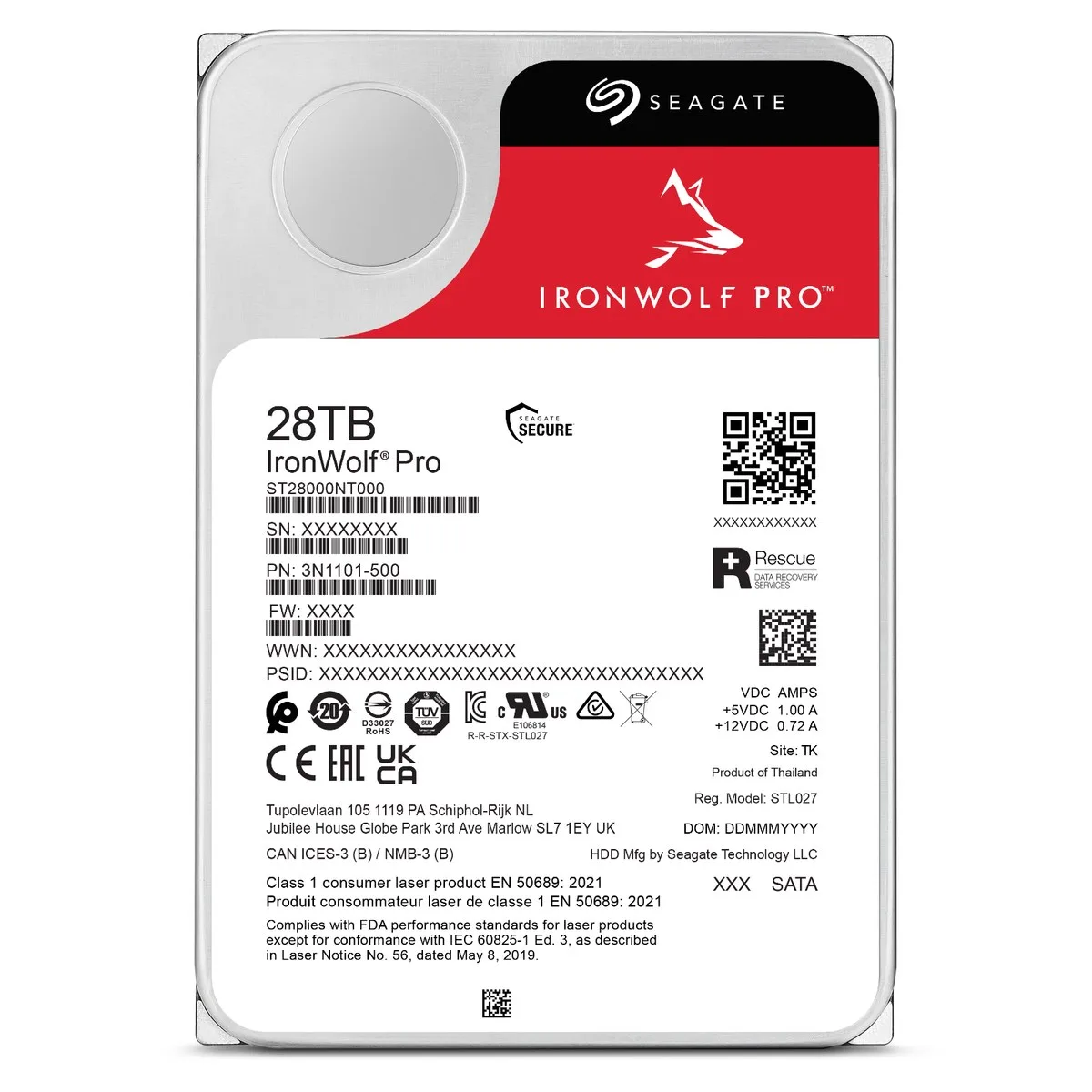
ST28000NT000 28TB
|
ST30000NT011 30TB
|
ST32000NT000 32TB
|
|
|---|---|---|---|
| Capacity | 28TB | 30TB | 32TB |
| Recording Technology | HAMR CMR | HAMR CMR | HAMR CMR |
| Interface | SATA 6Gb/s | SATA 6Gb/s | SATA 6Gb/s |
| Cache | 512MB | 512MB | 512MB |
| Max Sustained Transfer | 270 MB/s | 275 MB/s | 285 MB/s |
| Annual Workload | 550TB | 550TB | 550TB |
| MTBF | 2.5M hours | 2.5M hours | 2.5M hours |
| Average Operating Power | 8.3W | 8.3W | 8.3W |
| Limited Warranty | 5 years | 5 years | 5 years |
Which IronWolf Pro Capacity Should You Consider?
There is no single capacity that makes sense for every storage system. An existing NAS may need a specific qualified replacement, while a new deployment may benefit from higher-capacity drives that reduce the number of occupied bays.
The following verified models illustrate several capacity points in the family. They are examples for evaluation, not universal compatibility recommendations or a ranking based on sales volume. For any specific NAS, confirm that the exact model appears on the manufacturer's supported-drive list before purchasing.
IronWolf Pro Models to Evaluate
A helium-based 12TB CMR model with a 550TB/year workload rating.
A 16TB helium-based NT model rated for 270 MB/s maximum sustained transfers.
A newer-generation 20TB model with a 550TB/year workload rating.
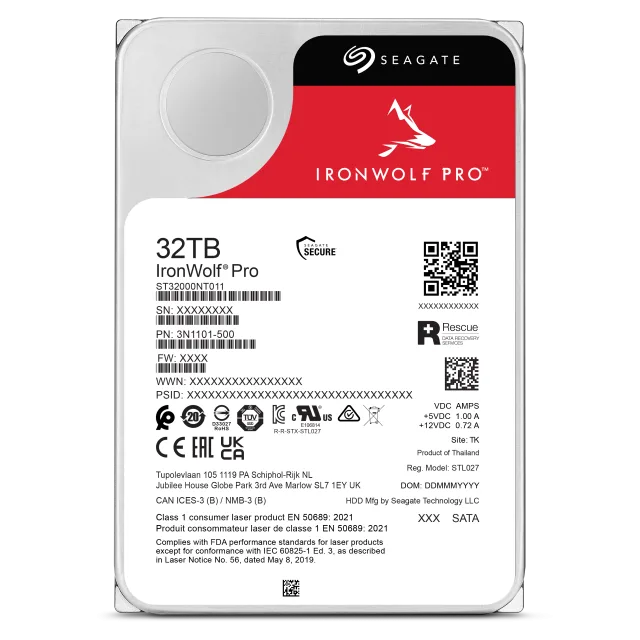
The highest-capacity verified IronWolf Pro HDD, using HAMR-assisted CMR recording.
Common Applications for IronWolf Pro Hard Drives
IronWolf Pro is primarily a NAS hard drive family, but its applications extend across several types of storage infrastructure. Choosing the right model depends on the workload, the capacity required and the system in which the drive will operate.
Business File Sharing and Multi-User NAS
Businesses commonly use NAS systems for shared folders, project files and centralized storage. IronWolf Pro's workload ratings, rotational vibration features and continuous-operation design align with these environments. Models such as ST12000NT001, ST16000NT001 and ST20000NT001 offer different capacity options, provided the storage platform supports them.
Backup and Disaster Recovery Storage
NAS-based backup repositories benefit from large HDD capacities and support for continuous operation. The appropriate drive size depends on backup retention, daily changes, available drive bays and expected restore requirements.
A RAID array is not a substitute for a separate backup. Protection against individual disk failure does not eliminate risks from accidental deletion, corruption, malware or loss of the entire storage system.
Creative Workflows and Shared Media Libraries
Photography studios, video production teams and other organizations may use NAS storage for shared project files and long-term media libraries. High-capacity models can increase storage per drive bay, while sequential transfer performance matters for large media files.
However, a mechanical hard drive has substantially higher access latency than an SSD. For highly demanding editing, caching or small-block random I/O workloads, SSD storage may provide a greater performance benefit.
Large-Capacity Archives
The 24TB, 28TB, 30TB and 32TB models are relevant when capacity per bay is a priority. These configurations require particular attention to drive qualification, cooling, RAID rebuild time and recovery planning.
Virtualization and Private Cloud Storage
Seagate has identified private cloud and virtual storage as intended use cases for IronWolf Pro. HDDs can be appropriate for capacity-oriented storage and backup repositories. Latency-sensitive virtual machines and write-intensive databases may be better served by SSD-based storage.
IronWolf Pro Workloads and Selection Considerations
| Application | Important Requirements | Models to Evaluate | Primary Limitation |
|---|---|---|---|
| Business NAS | Workload and multi-drive support | 12TB-20TB NT models | NAS qualification |
| Shared media storage | Capacity and sequential throughput | 16TB-32TB models | HDD latency |
| Backup repository | Capacity and restore planning | 12TB-32TB models | Backup redundancy |
| High-density archive | Capacity per bay and cooling | 24TB-32TB models | Rebuild and platform support |
| Legacy NAS replacement | Exact model compatibility | Approved NE or NT models | Controller and firmware restrictions |
| Virtualization | I/O pattern and latency | System-qualified models | Random I/O performance |
Seagate IronWolf Pro vs Other Storage Families
IronWolf Pro overlaps with several other NAS and enterprise hard drive families. Comparing them by model and intended workload is more useful than assuming that one family is universally superior.
IronWolf vs IronWolf Pro
Standard IronWolf targets home and smaller NAS installations, while IronWolf Pro is designed for more demanding business and multi-user use. Current standard IronWolf models are specified for up to 180TB/year workloads, compared with 550TB/year on newer IronWolf Pro models.
Older IronWolf Pro models had 300TB/year ratings, so that historical difference should remain visible when comparing used or previous-generation drives. Standard IronWolf products generally carry three-year limited warranties, while the verified IronWolf Pro HDD models covered here carry five-year limited warranties.
IronWolf Pro vs Seagate Exos
Seagate Exos is primarily positioned for enterprise and data-center storage, including storage servers and large infrastructure deployments. Some Exos models provide SAS connectivity, which IronWolf Pro HDDs do not.
For an approved NAS installation, IronWolf Pro may be the more straightforward product family to evaluate. For a server or storage array requiring a particular enterprise drive or SAS interface, the appropriately qualified Exos model may be the better fit.
IronWolf Pro vs WD Red Pro
WD Red Pro is a direct competitor in the business NAS category. Both families offer CMR drives, 7200 RPM operation, rotational vibration management, five-year limited warranties and models with 550TB/year workload ratings.
Capacity, published performance, acoustic specifications and NAS compatibility vary by model. The Western Digital Red Pro family reaches 26TB in the manufacturer information reviewed for this guide, while Seagate IronWolf Pro reaches 32TB.
IronWolf Pro vs Toshiba N300 Pro
Toshiba N300 Pro is another NAS-focused alternative. Its manufacturer documentation lists CMR recording, rotational vibration sensors, a five-year limited warranty and models rated for 550TB/year workloads. The reviewed lineup reaches 24TB and specifies operation in systems with up to 24 drive bays.
The appropriate choice depends on exact part numbers, system compatibility, operating characteristics and purchasing requirements rather than a family-wide performance assumption.
IronWolf Pro HDD vs IronWolf Pro 125 SSD
Despite sharing the IronWolf Pro name, the IronWolf Pro 125 SSD is a different product family. These 2.5-inch SATA solid-state drives use NAND flash instead of rotating magnetic media and are specified using SSD endurance metrics such as total bytes written.
An SSD may be preferable for low-latency access, intensive random I/O or supported NAS caching configurations. A mechanical IronWolf Pro HDD is primarily attractive when substantial storage capacity is required.
IronWolf Pro vs Related NAS and Enterprise Drive Families
| Product Family | Primary Application | Interface | Published Workload | Warranty | Main Distinction |
|---|---|---|---|---|---|
| Seagate IronWolf | Home and SOHO NAS | SATA | Up to 180TB/year | Typically 3 years | General NAS positioning |
| Seagate IronWolf Pro | Business and heavy NAS | SATA | 300TB or 550TB/year | 5 years | Multi-user NAS workloads |
| Seagate Exos | Enterprise storage | SATA or SAS | Up to 550TB/year | Typically 5 years | Data-center positioning |
| WD Red Pro | Business NAS | SATA | Up to 550TB/year | 5 years | Direct NAS competitor |
| Toshiba N300 Pro | Business NAS | SATA | Up to 550TB/year | 5 years | Up to 24-bay support |
| IronWolf Pro 125 SSD | NAS SSD storage | SATA SSD | TBW endurance metric | 5 years | Solid-state performance |
Buying and Compatibility Considerations
IronWolf Pro hard drives use standard SATA connectivity, but physical and electrical compatibility is not the same as confirmed support for a particular NAS, server or storage array.
A newer model can have the same advertised capacity as the installed drive and still require a firmware update, different qualification or additional configuration checks. This is especially important for proprietary storage appliances and systems that enforce approved-drive lists.
Check the Exact NAS or Server Model
Before purchasing, identify the storage appliance manufacturer, model and operating-system or firmware version. Check its supported-drive documentation for the exact Seagate model number and capacity.
Seagate recommends using the NAS manufacturer's compatibility list. Official resources include the Synology compatibility list and QNAP compatibility database. These lists may distinguish between approved, untested and unsupported drives.
SATA Interface and Drive Form Factor
The IronWolf Pro HDD models covered here use a 3.5-inch form factor with SATA 6Gb/s connectivity. The enclosure must provide suitable drive bays, power and interface connections.
A SATA drive is not automatically compatible with a SAS-only configuration. Some SAS controllers can operate with SATA drives, but support depends on the specific controller, backplane, firmware and storage system.
Sector Format and Controller Support
512e drives use 4KB physical sectors while exposing 512-byte logical sectors to the host. 4Kn drives expose native 4KB logical sectors. Sector format can matter for RAID controllers, operating systems and legacy storage appliances.
Many IronWolf Pro models in the reviewed datasheets use 512e, but historical specifications should be checked individually. Seagate's early documentation for ST2000NE0025 is not fully consistent regarding its sector presentation, making model-specific verification important.
RAID Configuration and Rebuilds
A replacement drive must satisfy the storage system's capacity and configuration requirements. Equal advertised capacity does not guarantee that the usable sector count or platform qualification will satisfy every array.
Rebuild time depends on drive capacity, RAID level, controller behavior, filesystem, competing workloads and other system factors. Larger drives can increase the amount of data involved in recovery, so storage redundancy and backup planning should be considered before expansion.
Power, Cooling and Acoustics
High-capacity mechanical drives generate heat and require adequate airflow. Startup current and steady-state power requirements also matter in enclosures with many drives. Seagate's datasheets list model-specific power and acoustic specifications, which should be checked when replacing an older drive with a different design.
For example, the two documented 24TB IronWolf Pro variants have different published noise ratings despite sharing the same advertised capacity.
Retail, OEM and Refurbished Drives
Retail and OEM drives can have different warranty channels, packaging and support arrangements. The manufacturer's standard family warranty does not guarantee that every individual drive carries the same remaining coverage.
When evaluating a refurbished drive, check the exact model, serial number, SMART data, power-on hours, self-test results, seller testing procedures and written warranty. A refurbished model can be useful for maintaining an older qualified system, but its condition and support terms need to be evaluated separately from those of a new retail drive.
Seagate provides official warranty and replacement resources for checking coverage and support options.
Replacing an Older Seagate IronWolf Pro Drive
One reason to research the complete IronWolf Pro catalog is to identify possible newer alternatives when an older model becomes difficult to source.
The transition from NE to NT is particularly relevant. Seagate released newer models at many of the same capacities, often with higher published workload and MTBF specifications. That does not establish universal interchangeability.
The table below identifies newer models worth investigating when replacing selected historical drives. These are potential replacement candidates, not confirmed drop-in replacements. The appropriate choice must be checked against the actual NAS, RAID controller, firmware and storage configuration.
Older IronWolf Pro Models and Potential Newer Alternatives
| Existing Model | Capacity | Newer Model to Evaluate | Main Difference | Compatibility |
|---|---|---|---|---|
| ST20000NE000 | 20TB | ST20000NT001 | 550TB vs 300TB workload | Requires verification |
| ST18000NE000 | 18TB | ST18000NT001 | Newer 550TB/year model | Requires verification |
| ST16000NE000 | 16TB | ST16000NT001 | Newer workload and transfer specs | Requires verification |
| ST12000NE0008 | 12TB | ST12000NT001 | Newer 550TB/year model | Requires verification |
| ST10000NE0004 | 10TB | ST10000NT001 | Newer model and specifications | Requires verification |
| ST8000NE0004 | 8TB | ST8000NT001 | Newer model and specifications | Requires verification |
| ST4000NE0025 | 4TB | ST4000NT001 | Newer model and cache | Requires verification |
| ST2000NE0025 | 2TB | ST2000NT001 | Newer model and specifications | Requires verification |
What to Verify Before Selecting a Replacement
- Read the installed drive label. Record the complete ST model number, capacity and any relevant firmware details.
- Identify the storage system. Confirm the NAS or server model, storage controller and software version.
- Check the approved-drive list. Search for the proposed replacement's exact model number, not just its capacity or product family.
- Verify capacity and sector configuration. Confirm that the RAID system can accept the proposed model and its usable capacity.
- Review firmware, power and cooling. Check for model-specific requirements and enclosure limitations.
- Confirm warranty and condition. Understand whether the drive is new, OEM, refurbished or used and what coverage actually applies.
If a storage system requires an exact OEM part number or drive qualification, selecting another IronWolf Pro model solely because it has the same interface and capacity may not be sufficient. In those cases, the original equipment manufacturer's documentation should determine the replacement decision.
Common Mistakes When Comparing IronWolf Pro Drives
- Comparing only capacity: Same-capacity drives may have different caches, transfer rates, acoustics and recording designs.
- Assuming all models have a 550TB/year workload rating: Older IronWolf Pro drives commonly specify 300TB/year.
- Confusing HAMR with SMR: The verified HAMR IronWolf Pro HDD models retain CMR recording behavior.
- Assuming a higher MTBF guarantees a longer individual lifespan: MTBF is a statistical specification, not a guaranteed replacement interval.
- Ignoring NAS firmware and qualification: SATA connectivity does not guarantee that a drive is supported in a particular storage appliance.
- Assuming all NT and NTZ identifiers are equivalent: Some Z-suffix products have inconsistent documentation and different product-family classifications.
- Assuming a manufacturer's five-year warranty applies to every used drive: Actual coverage depends on the individual product, distribution channel and warranty status.
- Overlooking RAID rebuild planning: Larger individual drives can change recovery requirements and the consequences of an additional drive failure.
Manufacturer Documentation and Specification Sources
The technical model information in this guide is based on Seagate manufacturer documentation, including historical datasheets that preserve part numbers no longer emphasized in the current catalog. These documents are useful when confirming an exact model or evaluating a possible replacement.
- Seagate IronWolf Pro Support and Model Index
- IronWolf Pro 28TB, 30TB and 32TB Datasheet
- IronWolf Pro 24TB HAMR Datasheet
- IronWolf Pro NT-Series Datasheet
- Historical IronWolf Pro NE and NT Specifications
- Historical IronWolf Pro 2017 Datasheet
- Original IronWolf Pro 2016 Datasheet
- Z-Series Model Datasheet (Contains Classification Inconsistencies)
Specifications reflect the documented models and source revisions available during research in November 2026. Actual system compatibility, available inventory, warranty status and individual-drive condition require separate confirmation.
Choosing the Right Seagate IronWolf Pro Drive
Start with the exact model number and the requirements of the storage system. For a new NAS deployment, evaluate capacity, annual workload, power consumption, acoustics and approved-drive compatibility. For an existing array, confirm the installed model and the manufacturer's replacement requirements before choosing a newer alternative.
IronWolf Pro has evolved considerably since its introduction in 2016. The older NE models, newer NT revisions and high-capacity HAMR products share a product-family name, but they do not all share identical specifications. Understanding those distinctions is the most reliable way to compare models and make an informed purchase.
What is the difference between Seagate IronWolf and IronWolf Pro?
Standard IronWolf is positioned for general NAS use, while IronWolf Pro targets heavier business and multi-user workloads. Newer Pro models carry 550TB/year workload ratings and five-year limited warranties, although older Pro models were commonly rated for 300TB/year.
What is the largest Seagate IronWolf Pro hard drive?
The largest verified model in the November 2026 research is ST32000NT000, a 32TB HAMR-based SATA hard drive with a 512MB cache and 550TB/year workload rating.
Are all Seagate IronWolf Pro drives CMR?
The verified mechanical IronWolf Pro models covered in the reviewed manufacturer datasheets use CMR recording. Newer HAMR models use heat-assisted technology while retaining CMR recording behavior, rather than SMR.
What is the difference between ST20000NE000 and ST20000NT001?
Both are 20TB IronWolf Pro SATA drives with 256MB caches and published maximum sustained transfer rates of 285 MB/s. The older NE model carries a 300TB/year workload rating and 1.2-million-hour MTBF, while the NT model is rated for 550TB/year and 2.5 million hours.
Are ST24000NT002 and ST24000NT031 the same drive?
No. Both are 24TB IronWolf Pro models, but ST24000NT002 is a helium-based non-HAMR drive rated at 285 MB/s maximum sustained transfers, while ST24000NT031 uses HAMR and is rated at 240 MB/s. Their published acoustic specifications also differ.
Can I replace an older IronWolf Pro NE drive with an NT model?
A newer NT model with the same capacity may be a potential replacement, but it is not automatically a confirmed drop-in substitute. Check the NAS or storage controller compatibility list, firmware, sector requirements and array configuration.
Can Seagate IronWolf Pro drives be used in servers?
They can be suitable for servers that support the exact 3.5-inch SATA model and capacity. SAS-only configurations, proprietary storage systems and vendor-qualified arrays require specific compatibility checks.
Is Seagate IronWolf Pro better than Seagate Exos?
Neither family is universally better. IronWolf Pro is primarily designed for NAS workloads, while Exos targets broader enterprise and data-center storage applications and includes SAS options. Choose according to the intended workload and the storage platform's approved models.
How long do Seagate IronWolf Pro hard drives last?
There is no guaranteed operating lifespan. Published MTBF specifications vary from 1.2 million hours on certain historical models to 2.5 million hours on newer models, but those are statistical reliability figures rather than promises of individual-drive lifespan.
Are refurbished IronWolf Pro drives worth buying?
Refurbished drives can be suitable for supported storage systems, especially when maintaining an older configuration, but condition and warranty coverage matter. Verify the exact model, SMART results, power-on hours, testing history and seller warranty before purchasing.