Passive Copper Cables vs Active Optical Cables Explained
Compare reach, speed, power, cost, and installation requirements before you choose
-
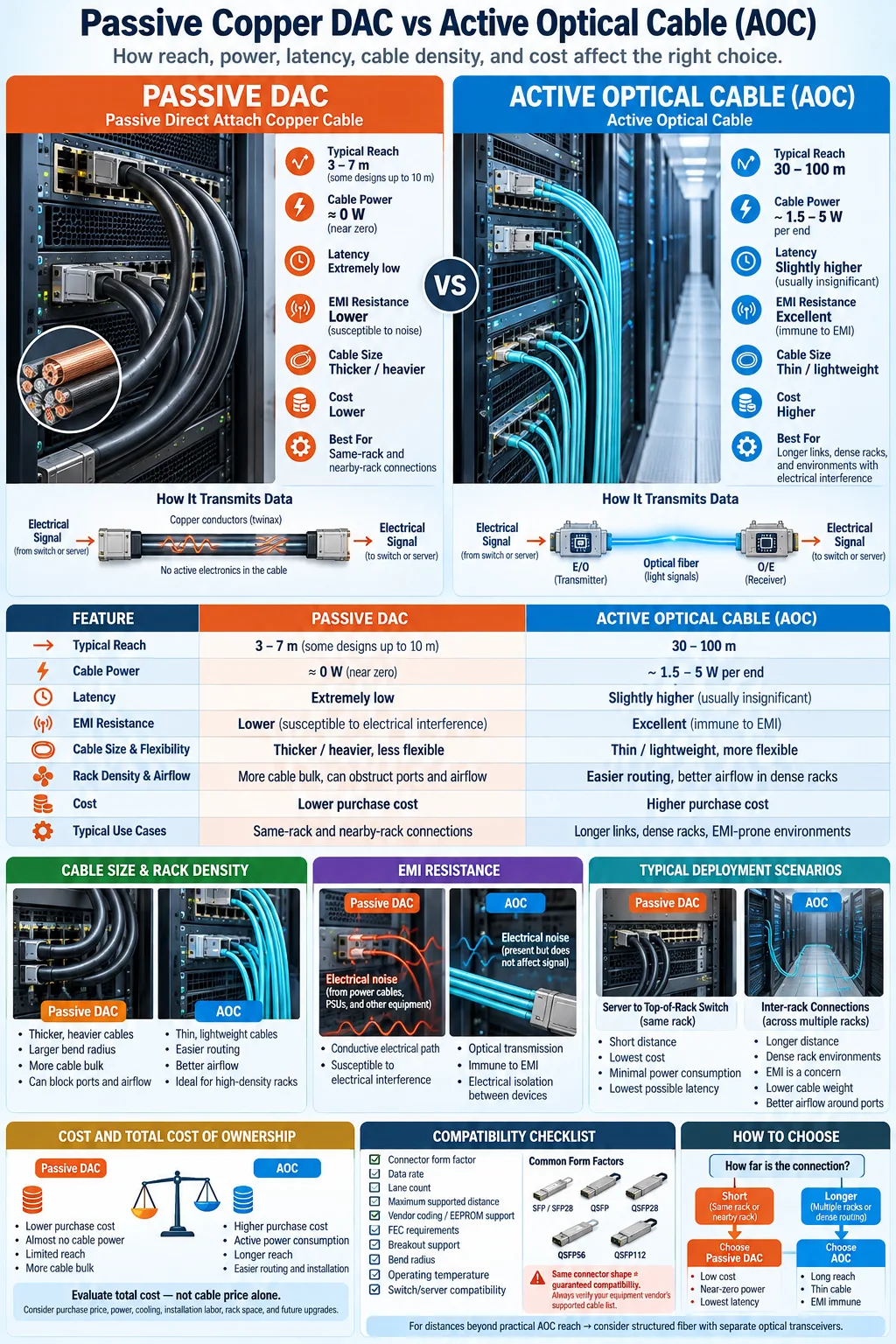
Passive DAC cables use almost no power and add virtually no latency, but they usually reach only 7 to 10 meters.
-
AOCs use electro-optical components for reaches up to 100 meters, resist electromagnetic interference, and typically use 1.5W to 5W per end.
-
Copper cables are thicker and harder to route in dense racks, while AOCs are lighter, thinner, and easier to manage.
Choosing between passive copper cables and active optical cables affects more than the connection between two switches. The cable type influences reach, power use, latency, airflow, rack organization, and long-term operating cost. Passive direct attach copper is often the simplest and least expensive option for short links inside a rack or between nearby racks. Active optical cables become more attractive as distances increase, racks become denser, or electromagnetic noise becomes a concern. This guide explains how both technologies work, where each performs best, and which engineering details you should check before ordering.
What Are Passive Copper Cables and Active Optical Cables?
Definition of Passive Direct Attach Copper (DAC) Cables
Passive Direct Attach Copper (DAC) cables are factory-terminated assemblies that connect compatible network ports without active signal electronics in the cable ends. They commonly use twinaxial copper conductors, which provide controlled impedance and good high-speed electrical performance over short distances. A DAC typically has transceiver housings on both ends, but the electrical path between those housings remains passive.
Definition of Active Optical Cables (AOC)
An Active Optical Cable (AOC) combines optical fiber with electronic components built into its connector housings. These components convert electrical signals to light at one end and convert them back to electrical signals at the other. AOCs can support longer links than passive copper while retaining a permanently attached, plug-and-play cable design.
Basic Construction and Components
Both cable types are designed for high-speed SerDes interfaces used by switches, servers, storage systems, and accelerators. A passive DAC generally contains copper pairs, shielding, connectors, and identification memory. An AOC contains optical fiber, electrical-to-optical circuitry, optical-to-electrical circuitry, connector electronics, and often VCSEL based transmitters. The cable ends must still match the port form factor and data rate, such as SFP, SFP28, QSFP, QSFP28, QSFP56, or QSFP112. The connector shape alone does not guarantee compatibility, so verify the equipment vendor's supported cable list.
How Do Passive Copper and Active Optical Cables Work?
Signal Transmission in Passive DACs
In a passive DAC, the switch or server generates an electrical signal and sends it directly through the copper conductors. The signal path has no optical conversion and normally no powered repeater inside the cable. Because the cable does not actively reshape or regenerate the signal, its performance depends heavily on conductor quality, shielding, impedance control, connector design, and the transmitter and receiver capabilities in the connected equipment.
Signal Conversion in Active Optical Cables
An AOC uses electro-optical transceivers integrated into the cable ends. At the transmitting end, electrical data from the SerDes interface drives optical components. At the receiving end, photodetectors and receiver electronics convert the light back into an electrical signal. Many AOCs use VCSEL drivers with multimode fiber because this combination supports high data rates over common data center distances.
Role of Equalization and Retimers
Equalization compensates for signal loss and distortion, allowing the receiver to interpret data after it has traveled through a lossy channel. A cable assembly may rely on equalization in the host equipment or include additional signal conditioning in its active electronics. Retimers go further by recovering the data clock and retransmitting a cleaner signal. Standard AOCs do not always include retimers, so you should not assume that every active cable regenerates the signal. The exact design depends on the data rate, reach, connector type, and manufacturer.
Key Differences Between Passive Copper and Active Optical Cables
Cable Length and Reach Limitations
The most important difference is cable length. Passive DACs commonly work well at distances up to 3 meters, 5 meters, or sometimes 7 to 10 meters, depending on the signaling rate and cable construction. Higher data rates generally reduce the practical maximum. AOCs can commonly reach 30 meters, 50 meters, or 100 meters, although the supported distance depends on the optical design and fiber type.
Power Consumption and Latency
Passive copper has essentially no cable-side power consumption. It also adds very little delay because the signal travels through a direct electrical connection. An AOC requires power for its transmitter, receiver, and signal conditioning electronics. Typical consumption may range from about 1.5W to 5W per end, depending on the speed and design. Its optical conversion adds a small amount of latency, but the difference is usually insignificant for most application traffic. In some high-performance environments, however, every nanosecond matters.
Physical Characteristics and Cable Management
Copper conductors require more metal and shielding as data rates and distances rise, so passive cables are often thicker and less flexible. AOCs use optical fiber, which allows a smaller cable diameter and lower weight. This makes it easier to preserve bend radius, label connections, separate airflow paths, and avoid blocking neighboring ports. Copper can be easier to terminate and inspect electrically, while AOCs require attention to optical cleanliness and connector handling.
Advantages of Active Optical Cables Over Passive Copper
Extended Reach and EMI Immunity
AOCs provide a major reach advantage when equipment is separated across a row, aisle, or room. Their fiber medium is naturally resistant to electromagnetic interference (EMI), ground noise, and crosstalk from nearby power systems. This makes them useful near motors, high-current equipment, dense accelerator systems, and electrical cables. AOC links also avoid many of the signal losses that limit long passive copper assemblies.
Lightweight and Flexible Design
An AOC's fiber core needs less conductive material than a high-speed copper cable. The result is usually a thinner, lighter cable that can be routed through crowded cabinets with less force on ports. This matters when you have hundreds or thousands of links. Better flexibility can also reduce bend-related stress, simplify service work, and make it easier to maintain a clean separation between power and data cabling.
Thermal Impact and Rack Space Efficiency
Although AOCs consume more cable-side power than passive DACs, their smaller diameter can improve airflow around switches and servers. Reduced cable bulk may free space in vertical managers and make it easier for fans to move air through the rack. The overall thermal impact depends on the complete installation. An AOC's electrical power becomes heat, while a dense bundle of copper can obstruct airflow and increase the cooling effort indirectly. In a high-density rack, the better choice is the cable that balances active power with manageable routing and unobstructed cooling.
Disadvantages and Limitations of Copper Cables
Shorter Maximum Cable Length
Passive copper is excellent for short connections, but its electrical channel loses signal quality as distance increases. Attenuation, insertion loss, return loss, and crosstalk become more difficult to control at higher data rates. A link that works reliably at 10 or 25 Gb/s may not support the same distance at 100, 200, or 400 Gb/s. Always check the cable's rated reach at the exact signaling speed you plan to use.
Thicker Cable Diameter and Handling Challenges
High-speed copper cables need shielding and carefully controlled conductors, which can make them thick and relatively stiff. Large bundles can cover port labels, block airflow, and make it harder to reach adjacent connectors. Excessive bending or pulling can also place stress on switch cages. Use the manufacturer's minimum bend radius, support heavy bundles with cable managers, and avoid forcing a connector into alignment.
Lack of Galvanic Isolation
Copper creates an electrical connection between the devices at both ends. This means it does not provide galvanic isolation against ground potential differences or certain forms of electrical noise. In well-designed data centers this may not cause a problem, but it can matter across separate rooms, buildings, or systems with different grounding conditions. Optical links avoid this conductive path because the data crosses the connection as light. That isolation can improve resilience and safety in electrically complex installations, though it does not remove the need for proper grounding and surge protection.
When to Choose Passive Copper vs Active Optical Cables
Use Cases Favoring Passive DACs
Choose passive DACs when the connection is short, the equipment is in the same rack, and the cable route is straightforward. They work well for server-to-switch links, top-of-rack deployments, storage connections, and short switch interconnects. Their low purchase price, near-zero cable power, and minimal delay make them attractive for large quantities of short links. DACs are also a practical choice when the network owner wants a simple electrical connection without optical cleaning or optical diagnostics.
Scenarios Ideal for Active Optical Cables
Choose AOCs when you need longer reach, low cable weight, flexible routing, or immunity to electrical noise. They suit end-of-row and middle-of-row designs, links between adjacent racks, high-density compute clusters, and environments with many power supplies or accelerator systems. AOCs are especially useful when thick copper bundles would interfere with airflow or consume too much cable-management space. For distances approaching or exceeding the AOC limit, consider a structured fiber link with separate optical transceivers instead.
Cost Considerations and Total Cost of Ownership
Passive DACs usually cost less at purchase and consume almost no cable power. AOCs cost more and add operating power, but they may reduce installation labor, rack congestion, and cooling constraints. Compare the total cost of ownership, including cable price, power, cooling, replacement effort, port compatibility, and the cost of future upgrades. A cheaper cable is not economical if it forces a rack redesign or cannot support the next network speed.
Engineering and Design Considerations
Thermal Management in Data Centers
Model both direct cable power and the physical effect of cable density. Passive DACs add little heat, but large copper bundles can restrict intake or exhaust airflow. AOCs create heat in their active ends, yet their smaller bodies may keep air passages more open. Leave adequate clearance around switch vents, use horizontal and vertical managers correctly, and avoid stacking cable loops in front of fan modules.
Impact on Network Latency and Performance
Passive copper generally offers the lowest possible cable delay. AOCs add conversion delay, but it is typically small compared with switching, buffering, and application processing. Performance depends more broadly on the host SerDes interface, switch ASIC, lane configuration, forward error correction, and signal integrity. Check whether the cable supports the required lane rate and coding method rather than judging it only by its connector or advertised aggregate speed.
Compatibility with Network Equipment
Verify the form factor, data rate, lane count, reach, temperature rating, and coding support before deployment. Some switches restrict third-party cables or require approved EEPROM identification. Confirm whether the port supports passive DAC, AOC, or both. For optical designs, check whether the cable uses OM3/OM4 fiber, and distinguish between OM3 fiber and OM4 fiber specifications when planning reach. Also review vendor requirements for breakout cables, FEC, firmware, and operating temperature. Testing a sample across the actual switch and server combination can prevent expensive installation problems.
Use passive DACs for short, low-cost links where minimal power and near-zero delay matter most. Move to AOCs when reach, rack density, flexibility, or electrical isolation becomes more important than the lowest purchase price. Before you buy, confirm the supported speed, distance, connector, host compatibility, bend radius, and thermal conditions. A cable decision made with the complete rack layout in view will deliver a more reliable network than one based on price alone.
Are passive DAC cables faster than active optical cables?
Passive DACs usually have slightly lower cable latency because they do not convert electrical signals to light. In most networks, the difference is very small and overall switch, server, and application processing has a much larger effect.
What is the maximum distance for a passive DAC cable?
Many passive DACs are rated for 3 to 7 meters, with some reaching 10 meters under suitable data rates and equipment conditions. Higher signaling speeds usually require shorter copper cables, so check the exact manufacturer rating.
How far can an active optical cable reach?
AOCs commonly support 30, 50, or 100 meters, depending on the data rate, optical components, and cable construction. Longer connections may require separate optical transceivers and structured fiber cabling.
Do active optical cables use more power than passive DACs?
Yes. AOCs power optical transmitters, receivers, and related electronics, often using about 1.5W to 5W per end. Passive DACs have almost no cable-side power consumption.
Are AOCs better for high-density data center racks?
They often are. AOCs are typically thinner, lighter, and more flexible, which can improve routing and airflow. However, you should include their active power use and compatibility requirements in the design.
Can I replace a passive DAC with an AOC without changing the ports?
Often yes, if the AOC uses the same supported connector form factor, speed, lane arrangement, and vendor coding. Always verify the switch and server compatibility list because some equipment limits which cable types it accepts.